How to Choose Industrial LED Spotlights in 2026?
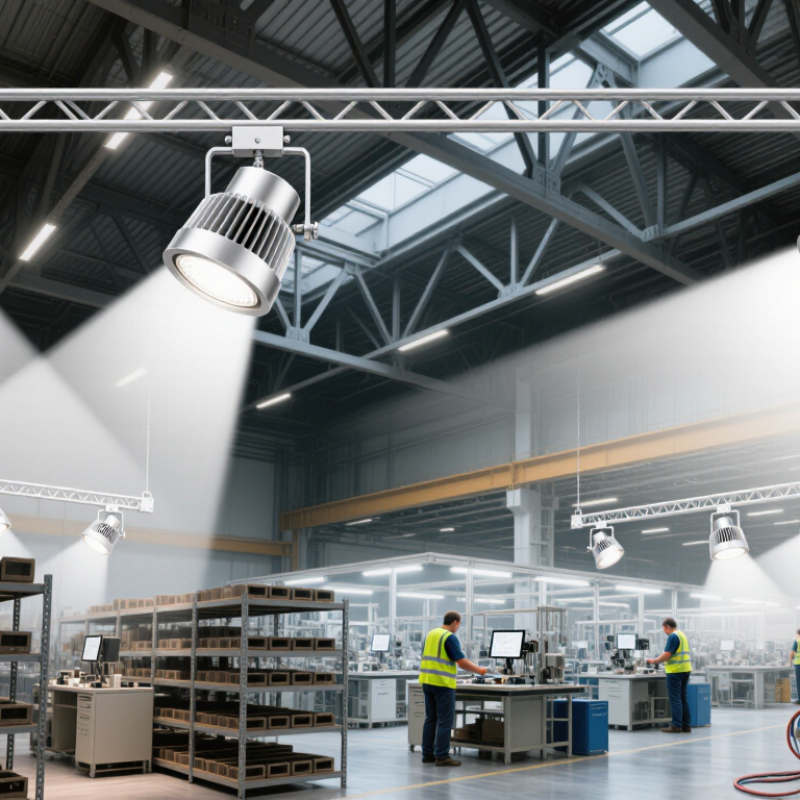
Choosing Industrial Led Spotlights in 2026 requires more than comparing wattage and price. Industrial spaces are demanding environments. Dust settles on housings, machinery creates vibration, and high ceilings make maintenance expensive. A spotlight that looks powerful in a showroom may produce harsh glare on a factory floor. It may also create dark areas beneath storage racks.
James R. Benya, a respected lighting designer and engineer, offers a valuable reminder: “Brightness alone does not make good lighting.” His point remains practical. Effective selection begins with the task, not the product label. Check the required illuminance, beam angle, mounting height, and working distance. A narrow 24-degree beam can highlight a loading station, while a wider 60-degree beam may suit an open production area. Consider CRI when workers inspect colors, cables, labels, or finished surfaces. Choose a suitable color temperature, often 4000K or 5000K, without assuming cooler light always improves productivity.
Look closely at IP and IK ratings. Check operating temperatures, flicker performance, surge protection, and heat dissipation. A sealed aluminum body with a reliable driver may outperform a cheaper fixture within two years. That is not guaranteed. Installation quality matters too. Poor aiming can waste output and increase glare.
This guide examines the decisions behind Industrial Led Spotlights in 2026. It considers energy use, controls, maintenance, safety, and total ownership cost. Some recommendations will depend on the site. Measure the space carefully. Then question the obvious choice.
Define Application Needs Using 130–200 lm/W Industrial LED Targets
How to Choose Industrial LED Spotlights in 2026?
Define Application Needs Using 130–200 lm/W Industrial LED Targets
Industrial LED selection should begin with the task, not the fixture catalogue. A warehouse aisle needs uniform lux, while a machine station needs controlled contrast. Measure mounting height, target illuminance, beam angle, operating hours, dust exposure, and ambient temperature. Then set a realistic luminaire efficacy target between 130 and 200 lm/W.
The U.S. Department of Energy’s Energy Savings Forecast of Solid-State Lighting in General Illumination Applications uses approximately 130 lm/W as a practical LED luminaire baseline. Its longer-term scenarios approach 200 lm/W. These figures describe complete luminaires, not bare LED packages. That distinction matters. Optics, drivers, thermal losses, and protective covers reduce delivered performance. Ask for LM-79 test data under the intended operating conditions.
Higher numbers are not always better. The DOE’s 2023 Solid-State Lighting R&D Opportunities report identifies research-level white-light efficacy targets near 255 lm/W for future systems. Industrial buyers should not confuse that laboratory direction with today’s installed spotlight. A 170 lm/W fixture with excellent glare control may outperform a 200 lm/W fixture that creates harsh reflections. Check maintenance factors, color quality, flicker, surge protection, and controls. Small details matter.
Be careful with optimistic datasheets. A real project can expose gaps. Test one bay first, review measured lux after installation, and revise the specification when evidence disagrees.
Select Beam Angles, CRI, and CCT for Specific Industrial Tasks
How to Choose Industrial LED Spotlights in 2026?
Select Beam Angles, CRI, and CCT for Specific Industrial Tasks
Choosing an industrial LED spotlight starts with the task, not the fixture. Beam angle controls light distribution across floors, machines, racks, and inspection areas. A narrow 15–30° beam suits high-bay targets or distant equipment. It can create harsh shadows near workers. A 40–60° beam spreads light more evenly across workstations and production lines. Measure the mounting height and target distance before selecting the angle. I have seen bright installations fail because the beam missed the actual inspection zone.
CRI matters when workers must identify surface defects, wiring colors, labels, or product finishes. A CRI above 80 often supports general industrial work. Inspection tasks may require CRI 90 or higher. Red tones can still look slightly weak, even with a high CRI rating.
CCT also changes visual comfort. Around 4000K provides a balanced appearance for warehouses and workshops. Around 5000K can improve contrast in detailed inspection areas, but may feel cold during long shifts.
Tips: Test one spotlight after dark or during normal operating hours. Compare beam coverage on the real surface. Check shadows behind pipes and machinery. Keep a simple lighting record. Note the beam angle, CRI, CCT, mounting height, and worker feedback. The first choice may be wrong. Adjustment is part of good lighting practice.
Verify IP65–IP69K, IK08–IK10, and 50,000–100,000-Hour Lifespans
How to Choose Industrial LED Spotlights in 2026?
In industrial lighting, IP ratings deserve careful verification. IP65 means a dust-tight enclosure with protection against water jets. IP66 handles stronger water jets, while IP67 concerns temporary immersion. IP68 depends on the manufacturer’s stated depth and duration. IP69K is different again, covering high-temperature, high-pressure cleaning. These ratings are not interchangeable. Ask for test reports, not just catalogue claims.
Impact protection matters near machinery, loading bays, and busy workshops. IK08 withstands 5 joules of impact, while IK10 withstands 20 joules. A dropped tool can expose weak housing, cracked lenses, or loose mounting points. Check the complete spotlight, including its lens and bracket. I have seen installations pass a visual inspection but fail after repeated vibration. That mistake is easy to make.
Lifespan claims also need context. A rating between 50,000 and 100,000 hours usually refers to LED maintenance, often measured as L70. It does not promise identical brightness for eleven years. Heat, dust, current, and switching cycles change performance. Look for operating-temperature data and thermal test results. In a hot ceiling, a lower-rated fixture may age faster. In a washdown area, even IP69K can disappoint if cable glands are poorly fitted. Leave room for doubt. Verify the evidence before choosing the highest number.
Compare Controls and Calculate Energy Savings of 50%–75%
How to Choose Industrial LED Spotlights in 2026?
Choose the control system before choosing the spotlight. A high-output LED fixture saves energy, but poor control can waste its advantage. Compare occupancy sensors, daylight dimming, time scheduling, and networked controls. Occupancy sensors suit storage aisles with irregular traffic. Daylight dimming works better near skylights or loading doors. Scheduling is simple, but it may ignore real work patterns. Networked controls provide detailed data, though setup and training require extra budget.
Use a measured calculation, not a sales estimate. Suppose 100 old fixtures use 300 watts each for 4,000 hours annually. Their consumption reaches 120,000 kilowatt-hours. Replacing them with 150-watt LED spotlights reduces usage to 60,000 kilowatt-hours, creating a 50% saving before controls. At $0.15 per kilowatt-hour, annual electricity costs fall from $18,000 to $9,000.
Controls can reduce the remaining LED energy by another 25% to 50%. The total saving becomes about 62.5% to 75%, if schedules and dimming levels match actual operations. Confirm driver compatibility, sensor coverage, minimum dimming output, and emergency-lighting requirements. A narrow beam may reduce fixture quantity, but glare can increase near reflective machinery. My early estimates were too optimistic because I ignored cleaning cycles and unoccupied maintenance hours. Record baseline meter data for at least two weeks, then verify savings after commissioning. Tiny adjustments matter.
Assess Certifications, Warranty Terms, and Total Cost of Ownership
Choosing industrial LED spotlights in 2026 requires more than comparing lumen output and purchase prices. Check certification records for the exact model, not only the product family. IEC 60598-1 supports general luminaire safety requirements, while IEC 62471 addresses photobiological risks. For North American projects, verify recognized laboratory certification and applicable energy-efficiency listings. The U.S. Department of Energy’s Solid-State Lighting research reports continue to show major gains in LED efficacy, but real performance depends on heat management, optics, and installation. A bright fixture can still waste energy.
Warranty terms deserve closer inspection. A five-year warranty sounds strong, yet exclusions may cover drivers, surge damage, or operation above rated temperature. Request the promised lumen-maintenance percentage, failure definition, claim process, and replacement lead time. The IEA’s Energy Efficiency 2024 analysis identifies efficient lighting as a practical electricity-saving measure, but savings disappear when fixtures require frequent replacement. No certificate predicts every failure. That is worth remembering.
Tips: Build a simple total-cost-of-ownership sheet. Include fixture price, installation labor, electricity, cleaning, controls, downtime, and disposal. Compare annualized cost over ten years. Use local electricity rates and measured operating hours. Ask for LM-80 and TM-21 evidence where relevant, plus photometric files for layout verification. I would also test a sample during a hot production shift. Laboratory data is useful, but factory dust and heat can expose weaknesses. My own caution: projected savings are often too optimistic. Leave room for maintenance and unexpected replacements.
Related Posts
-
Innovative Solutions Beyond Industrial Led Spotlights for Effective Lighting
-
Embracing 2025: Revolutionizing Industry with the Best LED Spotlights for Global Buyers
-

Navigating Global Standards for Importing Commercial Led Fixtures
-

Illuminate Your Space with Innovative Led Lighting Solutions for Global Buyers
-
Unwavering Quality in Best Led Lamps Made in China Trusted Worldwide
-
Unlocking the Benefits of Energy Efficient Led Fixtures for Sustainable Lighting Solutions