2026 How to Choose Outdoor Ceiling Fans for Global Buyers
Choosing an Outdoor Ceiling fan for global buyers requires more than comparing blade sizes or online prices. Climate, voltage, mounting conditions, and after-sales support can change the buying decision completely. A coastal villa in Dubai faces different demands from a covered patio in London. Salt air, intense sunlight, seasonal rain, and unstable electrical systems all deserve attention.
“An outdoor fan must be selected for the environment, not just the room,” says Matt DeLaney, a product specialist in the outdoor fan industry. This principle sounds simple, but many purchasing decisions still begin with appearance. That approach can create expensive mistakes. A stylish indoor-rated fan may corrode quickly outside. A powerful motor may also produce uncomfortable airflow in a small seating area.
This guide explains how global buyers can evaluate Outdoor Ceiling fans with practical confidence. It considers damp-rated and wet-rated construction, motor efficiency, blade span, ceiling height, airflow direction, remote controls, and regional electrical compatibility. Product certifications and warranty terms also matter. They provide useful evidence, although they do not replace careful installation and maintenance.
No checklist is perfect. Real sites are messier. A covered balcony may still receive wind-driven rain. A high ceiling may require a stronger downrod than expected. Buyers should inspect the installation location, measure the available space, and confirm local requirements before ordering. The best choice balances comfort, durability, energy use, design, and long-term service—not merely the lowest purchase price.
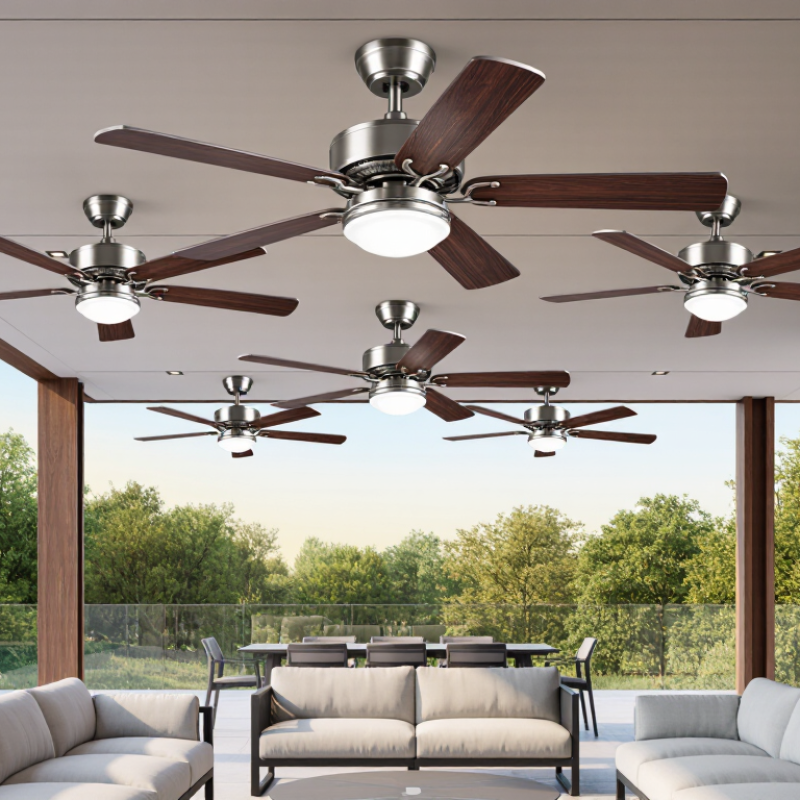
Understanding Outdoor Ceiling Fan Types and Global Climate Requirements
Outdoor ceiling fans must match both the space and its climate. A covered patio in Singapore faces humid air, salt, and frequent rain. A terrace in Spain faces intense heat, dust, and dry winds. These conditions require different materials, motor protection, and airflow designs.
The main types include damp-rated fans for sheltered areas and wet-rated fans for exposed locations. Wet-rated models need sealed electrical parts and corrosion-resistant finishes. In coastal regions, stainless-steel hardware is usually safer than untreated metal. Large blades move air slowly and quietly across wide seating areas. Smaller, faster blades suit compact balconies. A practical mistake is choosing only by diameter. Mounting height, ceiling shape, and nearby walls also control comfort.
The International Energy Agency reported that cooling demand could more than triple by 2050, rising from about 2,000 TWh in 2016 to 6,200 TWh. Efficient air movement can support cooling systems, but a fan does not lower room temperature. It only improves perceived comfort. ASHRAE Standard 55 links thermal comfort with air speed, humidity, and temperature. Buyers should therefore check airflow data, energy use, outdoor safety ratings, and local electrical requirements. In humid climates, reverse airflow may feel less useful. That judgment is not always obvious. Real testing matters.
How to Choose Outdoor Ceiling Fans for Global Buyers
Typical outdoor ceiling fan requirements by climate. Use the chart as an initial selection guide, then confirm local electrical, wind-load, corrosion, and installation requirements.
Hot and dry locations generally benefit from larger blade spans and higher airflow. Humid, tropical, and coastal environments require stronger moisture and corrosion protection; IP55 or higher is commonly preferred for exposed installations, while salt-air locations may also require corrosion-resistant materials and fasteners. The airflow and blade-span figures shown are indicative ranges for residential and light-commercial outdoor areas.
IP values refer to the IEC 60529 ingress-protection classification. Always verify the product’s actual certification and suitability for the installation environment.
Evaluating Motor Performance, Blade Design, and Airflow Efficiency
Outdoor ceiling fans face heat, humidity, dust, and sudden temperature changes. Global buyers should assess the motor before admiring the finish. A durable motor should run smoothly without buzzing, overheating, or noticeable speed drops. In practical checks, listen at low speed and inspect vibration at high speed. A sealed motor housing can reduce exposure to moisture, but it does not replace correct installation. Check the stated voltage, frequency, and approved outdoor-use rating for the target market.
Motor control also affects daily comfort and energy use. A brushless DC motor often provides quieter operation and more speed settings. However, efficiency claims need independent test data. Do not trust a large airflow number alone. Compare airflow volume, power consumption, and noise under similar conditions. Real performance may change when the fan hangs beneath a low roof or near a wall.
Blade design directs that performance into the room. Longer blades can move more air, but they require suitable clearance and stronger structural support. Blade pitch matters too. A moderate pitch may balance airflow and motor load better than an aggressive angle. Three blades can feel responsive, while four or five blades may produce a steadier breeze. This is not universal. I have seen attractive fans create weak airflow because their blades were poorly matched to the motor. Measure the occupied area, ceiling height, and prevailing wind before choosing. Leave enough space around each blade, especially on covered patios.
Selecting Weather-Resistant Materials and Suitable Safety Ratings
2026 How to Choose Outdoor Ceiling Fans for Global Buyers
Outdoor fans face rain, salt, ultraviolet light, dust, and sudden temperature changes. Stainless steel fasteners resist rust around coastal homes, while powder-coated aluminum protects the motor housing. UV-stabilized polymers can prevent brittle blades, although cheap plastic may still discolor. It is worth checking the coating thickness and corrosion testing, not only the product photograph.
Choose an ingress protection rating for the installation site. IPX4 resists water splashes, while IPX5 handles water jets under defined laboratory conditions. IP ratings do not prove corrosion resistance or safe mounting. The fan should also meet IEC 60335-2-80, or the relevant national safety standard, with verified thermal protection and secure blade guards. Local certification remains essential because approval requirements differ between markets.
Energy demand gives this choice broader importance. The International Energy Agency’s The Future of Cooling report projects global cooling electricity demand could more than triple, reaching about 6,200 TWh annually by 2050. Efficient motors and reversible airflow can reduce air-conditioner dependence, but performance depends on room height and humidity. A practical inspection should check sealed bearings, drainage paths, cable glands, and ceiling brackets. One detail is often missed: salt spray can attack screws before the motor fails. IP55 sounds reassuring, yet it does not replace a coastal corrosion specification. My own buying rule would be stricter than the datasheet, though that may increase cost unnecessarily.
Comparing Energy Use, Controls, Installation, and Maintenance Needs
For global buyers, outdoor ceiling fan selection should begin with energy use, not blade diameter alone. The International Energy Agency projects space-cooling energy demand could more than triple by 2050. Efficient air movement is becoming increasingly practical. The U.S. Department of Energy explains that fans cool people, not rooms. Raising a thermostat by about 4°F may maintain comfort when airflow reaches occupants. Switch the fan off when the patio is empty. It is a small detail.
ENERGY STAR reports that certified ceiling fans can use up to 60% less energy than conventional models. Compare motor wattage, airflow, and efficiency ratings together. A low-wattage fan is not automatically effective. Choose controls that match the site: wall switches suit shared areas, while remotes help with tall ceilings. Timers prevent overnight operation. Smart controls are useful, but outdoor connectivity can be unreliable. I would not assume the most advanced control is the best one.
Installation needs careful attention. Confirm the fan is rated for the outdoor exposure, especially near salt air or frequent rain. A qualified electrician should check mounting strength, wiring, grounding, and clearance. Maintenance is simple but easy to neglect. Clean blades every few months, inspect fasteners, and watch for wobbling or unusual noise. Dust and corrosion reduce performance. My own preference is a simpler system, although that may sacrifice convenience. The better choice depends on climate, access, and who will maintain it. Sources: U.S. Department of Energy, Energy Saver guidance; ENERGY STAR Ceiling Fan Performance Data; International Energy Agency, The Future of Cooling.